Showing posts with label Newbery. Show all posts

Wednesday, December 2, 2015

Flora & Ulysses: The Illuminated Adventures


Title: Flora & Ulysses: The Illuminated Adventures
Author: Kate DiCamillo
Illustrator: K. G. Campbell
Publisher: Sommersville, MA: Candlewick Press, 2013
ISBN: 978-0-7636-6040-6 

Summary: 10-year-old cynic Flora Belle Buckman lived a boring life—her only excitement came in the form of her comic books starring The Amazing Incandesto—until the day the next-door neighbor’s vacuum cleaner sucked up a common squirrel and he emerged as Ulysses, the super-strong, flying, poetry-writing superhero rodent! As she serves as Ulysses’ mentor and guardian, Flora’s life becomes more interesting. Aside from teaching Ulysses how to use his power for good, Flora has to determine Ulysses’ arch-nemesis. Is his mortal enemy the new boy next door, the cat at her father’s apartment building, Mary Ann, or (gasp) her own mother? Only a series of misadventures will tell!
 

Critical Analysis: DiCamillo’s Newbery-winning Flora & Ulysses transitional novel is a fun jaunt into low fantasy. Short chapters written from two viewpoints and sprinkled with full page illustrations liven the reading.   Flora & Ulysses is told in two different styles—DiCamillo’s text gives way at certain points and is replaced by Campbell’s humorous comic strip-style illustrations to move the comical story along. The combination should appeal to transitional and experienced readers alike. Full of fun-to-say words like “Holy Bagumba,” “quark,” “seal blubber,” and “malfeasance” make this a cheery read-aloud for middle elementary and up. 

The real beauty of the novel is the characters—they are wacky and loveable. The new boy, William Spiver, has a vocabulary beyond his years (as does Flora) and a psychosomatic vision disorder. Flora’s mom is amusingly annoyed and angry; her father is absent-minded; her neighbor Mrs.Tootie Tickham is relatively normal; and Dr. Meescham is upbeat and full of faith. Mary Ann is just smug, a pretty impressive feat for a lamp. They are all great fun, but Flora and Ulysses are the strongest.  

Flora’s cynical mantra is “Do not hope; instead, observe.” At the beginning of the novel she has wrapped herself into a cynical cocoon, escaping into comic books and avoiding her mother. However, her efforts to squash hope prove futile because one can’t help but feel that things will get better with a superhero around. Her confidence in comic books as reference material in coping with everything from training superheroes to CPR is amusing. DiCamillo manages to make her protagonist prickly, tender, and relatable all at once. Ulysses, being a squirrel, is more limited in his depth, yet it makes perfect sense that his thoughts tend to be centered around food and Flora’s lovely round head. 

It all boils down to a laugh-out-loud tale of discovering hope. And a superhero squirrel.

 
Awards:

2014 Newbery Medal
2014 Texas Bluebonnet Award
A Junior Library Guild Selection


Reviews:

 School Library Journal: “Rife with marvelously rich vocabulary reminiscent of the early superhero era…and amusing glimpses at the world from the point of view of Ulysses the supersquirrel, this book will appeal to a broad audience of sophisticated readers. There are plenty of action sequences, but the novel primarily swells in the realm of sensitive, hopeful, and quietly philosophical literature.”

Publishers Weekly: “Despite supremely quirky characters and dialogue worthy of an SAT prep class, there’s real emotion at the heart of this story involving two kids who have been failed by the most important people in their lives: their parents.”

Huffington Post: “laugh-out-loud funny, tender, difficult and hopeful all at once…Cynics beware, this book is meant for those open to joy, wonder, loyalty and friendship of all stripes.”


.Activity and Website:
Create your own superhero. Would you use an animal? If so, what animal would you choose? What awesome name would you give your superhero? No hero would be complete without an arch-enemy. Who would be your hero’s nemesis?

Will the Heimlich Maneuver work on a squirrel? Find out how to do the Heimlich Maneuver
 
Created for Texas Woman’s University course LS 5603.21

Wednesday, November 11, 2015

The Evolution of Calpurnia Tate

Title: The Evolution of Calpurnia Tate
Author: Jacqueline Kelly
Publisher: New York: Macmillan, 2009
ISBN: 978-0-312-65930-1

Summary: Calpurnia Tate is your average Southern eleven-year-old girl in a houseful of brothers, a mother trying to teach her to be a lady, a cantankerous grandfather, and a taste for forbidden books. Actually, this budding scientist isn’t ordinary at all as she strives to learn all she can about the natural world with her grandfather and Mr. Darwin’s help and as she strives to avoid her mother’s attempts at bringing up a proper young lady in 1899.

Critical Analysis: Jacqueline Kelly’s debut novel is full of character and science. Calpurnia and her grandfather are the main characters but Calpurnia’s world does contain others; her parents, brothers, and servant Viola—all well-loved people. To a lesser extent you have a few friends and a love interest of Calpurnia’s brother, characters used primarily to move the book along.

Calpurnia is a great character and narrator; she’s spunky and entertaining. Her grandfather is gruff and mysterious. They’re both interesting and multi-faceted, but together they are dynamic. Calpurnia is polite in a genteel Southern way—mam’ and sir being second nature. The talents and skills expected of her as a Southern lady are accurately described, as well as her distaste for them.

Her grandfather is not only a character, he is also the driving force behind the science contained in the novel. His interest in nature began when he made friends with a bat during the Civil War. The story of the bat in his tent is the only war story you get to here this veteran tell. He pushes Calpurnia’s scientific studies by allowing her to work with him in his field studies.

The book is episodic in its plotline. Short, primarily funny, vignettes occur and in-between the stories Calpurnia grows a little. Kelly’s writing is smooth and vivid, drawing you into the sweltering Texas summer or tension-filled piano recital.

The author makes no reference to sources used for the book, although the acknowledgments section thanks several people and institutions connected with science and history. Kelly was a practicing medical doctor for many years before switching careers; she draws on Charles Darwin’s Evolution of Species and her personal knowledge of the natural world for the science in The Evolution of Calpurnia Tate.

Although the novel has a specific setting and time period, it is not focused around a historic event. The historical aspect of this novel comes into play primarily in the attitudes and expectations of society toward young women. Calpurnia’s chafing against those expectations is universal and continues to this day as we push against what society expects of us.


Awards:
2010 Newberry Honor Book
2010 YALSA Best Book for Young Adults
2010 ALA Notable Book
2009 Chicago Public Library Best of the Best

Reviews:

Kirkus Reviews: “Readers will finish this witty, deftly crafted debut novel rooting for ‘Callie Vee’ and wishing they knew what kind of adult she would become.”

The Horn Book: “Kelly, without anachronism, has created a memorable, warm, spirited young woman who’s refreshingly ahead of her time.”

The New Yorker: “…the most delightful historical novel for tweens in many, many years…Callie’s struggles to find a place in the world where she’ll be encouraged in the gawky joys of intellectual curiosity are fresh, funny, and poignant today.”

Neat Stuff to Learn:
Learn more about Grasshoppers:
http://bugguide.net/node/view/73/tree/all

This is a picture of a flower similar to that discovered by Calpurnia and her grandfather. What would you name a plant?
Check out my Book Trailer:


Cotton:
Cotton is THE cash crop of Callie’s Family. Learn more about where your t-shirt comes from by watching this prezi by Matthew Green. Then go to  kqed.org  for more great information about your t-shirt.
review created for Texas Woman’s University course LS 5603.21

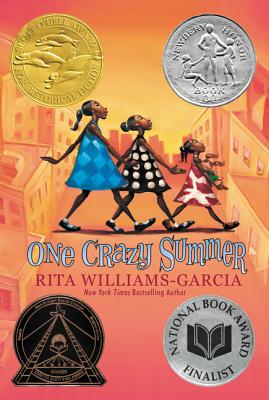
One Crazy Summer

Title: One Crazy Summer
Author: Rita Williams-Garcia
Publisher: New York: HarperCollins, 2010
ISBN: 978-0-06-076090-8

Summary: “How can you send them to Oakland? Oakland’s nothing but a boiling pot of trouble cooking.” 
–Big Ma

It’s the summer of 1968 and Delphine and her two younger sisters are sent by their father and Big Ma (their grandmother) in Brooklyn, NY, to Oakland, CA, to visit their mother. But their California dreaming crashes down on them as they realize they will not be visiting Disneyland and surfing as they had hoped. Instead they are busy avoiding the crazy mother who abandoned them as babies, attending summer school taught by black panthers, and a learning a few truths they never knew. Just don’t tell their Big Ma.

Critical Analysis: Rita Williams-Garcia creates not so much a world (that was already there) as the people that inhabit it—especially the women. Delphine, Vonetta, and Fern are sisters ranging in age from 11 to 7, each with her own strong personality. Their mother, Cecile or Nzila, is crazy and distant, a poet quietly caught up in the black power movement of the 1960’s. Their grandmother, Big Ma, is heard throughout the story as a conservative voice in the head of our narrator.

The story is told through the eyes of 11-year-old Delphine. When their mother abandoned them Delphine took on responsibility for her younger sisters. The reader senses her vigilance in guarding Vonetta and Fern, her big-sister ability to press the right buttons in her younger sister’s attitudes, and her resentment toward her mother for leaving them. We see Delphine’s comprehension about the way the world works slowly shift as she is exposed to the ideals of the Black Panthers and her evolving role as a black woman.

The novel revolves around the sisters, especially Delphine, and their relationship with their mother. While the girls essentially wait for their mother to acknowledge their existence beyond people who need to be fed and sleep somewhere, they become involved in a summer education program run by the Black Panthers at the People’s Center.

Their adventures at the People’s Center are just like any other children’s in any summer school; there are friends to be made from enemies, playground games, teachers trying (sometimes succeeding) to help. Then Nzila is arrested with a couple of Black Panthers and the girls are left on their own. Instead of calling Pa and Big Ma, Delphine decides to wait for Cecile to be released from jail. The sisters stay busy with preparations for a rally in the park. The girls discover a poem written by their mother and decide to recite it as their part in the rally. The plot is quickly but powerfully resolved as Cecile finally speaks to Delphine about why she left.

Rita Williams-Garcia writes not only from her personal knowledge of growing up during the civil rights movement, but also from extensive research from a variety of sources. The descriptions of the time and area are accurate. Even the stereotyping is accurate—meaning that some of the characters view other characters as stereotypes, such as one of the Panthers continually calling the police “pigs”.

The book may be written in a certain time and a certain place, but the characters could be in any setting. The girls’ pain and confusion as a consequence of abandonment and how they deal with facing the unknown are emotions we are all familiar with to one extent or another. Delphine is not alone in having to come to terms with the underlying motivations to action; it is something we all must face.

Awards:
Newberry Honor Book
Coretta Scott King Award
National Book Award Finalist
Scott O’Dell Award for Historical Fiction
ALA Notable Book
NAACP Image Award Nominee
Parent’s Choice Gold Award

Reviews:

Monica Edinger, New York Times: “In One Crazy Summer Williams-Garcia presents a child’s-eye view of the Black Panther movement within a powerful and affecting story of sisterhood and motherhood.”

Horn Book: “The setting and time period are as vividly realized as the characters, and readers will want to know more about Delphine and her sisters after they return to Brooklyn.”

Linda Sue Park, Newbery Medal-winning author of A Single Shard: “A genuine rarity: a book that is both important in its contents and utterly engaging in its characters…with the tremendous bonus of being beautifully written.”

Author Quote:
“I wanted to share an era in which I had enjoyed my childhood—the late 1960’s…My siblings and I indulged in now-vanishing pastimes. We played hard. Read books. Colored with crayons. Rode bikes. Spoke as children spoke. Dreamed our childish dreams…[our parents] gave us a place to be children and kept the adult world in its place—as best as they could.”
--excerpt from Rita Williams-Garcia’s Acceptance Speech for the Coretta Scott King Author Award for One Crazy Summer
Activity and Websites:
Make a playlist including songs from 1968
Pretend you are eating Mean Lady Ming Takeout by trying this recipe for fortune cookies: kidspot fortune cookies
Find out more about the Civil Rights Movement:
http://www.history.com/topics/black-history/civil-rights-movement
Created for Texas Woman’s University course LS 5603.21

Wednesday, October 21, 2015

Bomb: The Race to Build--and Steal--the World's Most Dangerous Weapon

Title: Bomb: The Race to Build—and Steal—the World’s Most Dangerous Weapon
Author: Steve Sheinkin
Publisher: New York: Roaring Brook Press, 2012
ISBN: 978-1-59643-487-5

Summary: Taking us from the birth of the split uranium atom in 1938 to the beginning of the Cold War, Sheinkin introduces major players from science, espionage, and politics like Oppenheimer, Gold, and FDR respectively, and examines their contributions and hindrances to the development and use of the Atomic bomb.

Critical Analysis: Although Sheinkin divides his history of the atomic bomb creation into four parts—Three-Way Race, Chain Reactions, How to Build an Atomic Bomb, and Final Assembly—the book is far more than the sum of its parts. Using not only exciting text and photographs, but also the build-up and rapid pacing of a spy movie, Sheinkin draws us into a world filled with conflicted heroes, fanatical traitors, and a few people who are just doing their job. Reading of U.S. lead scientist Robert Oppenheimer’s physicist recruitment efforts and of the struggles of Russia’s KGB’s to obtain spies, both nations desperately seeking reliable people to work at the U.S. National Laboratory in Los Alamos, the secrecy practically begs one to whisper if reading aloud.
.
The organization and research of Bomb is impeccable, justifying Sheinkin’s reputation as a trustworthy author. An easily navigated table of contents and a comprehensive index make it easy to find exactly what you seek. Pulling from a great range of authoritative primary and secondary sources, Sheinkin’s research is exhaustive. Almost twenty pages using very small font, the author notes, bibliography, and quotation notes authenticate the facts, descriptions, and dialogue used in the book.

Scheinkin has the rare talent of making WWII history buffs sit on the edge of their seats even though they already know how the story ends.

Awards:
2013 Sibert Medal
2013 YALSA Award for Excellence in Nonfiction
2013 Newbery Medal Honor Book
2012 National Book Award Finalist for Young People's Literature
National Book Awards Finalist

Reviews:

Wall Street Journal: "This superb and exciting work of nonfiction would be a fine tonic for any jaded adolescent who thinks history is "boring." It's also an excellent primer for adult readers who may have forgotten, or never learned, the remarkable story of how nuclear weaponry was first imagined, invented and deployed--and of how an international arms race began well before there was such a thing as an atomic bomb.”

Booklist: “[a] complicated thriller that intercuts action with the deftness of a Hollywood blockbuster

School Library Journal: " ...reads like an international spy thriller, and that's the beauty of it.

Kirkus Book Reviews: “It takes a lot of work to make a complicated subject clear and exciting, and from his prodigious research and storytelling skill, Sheinkin has created a nonfiction story young people will want to read. A superb tale of an era and an effort that forever changed our world.”

Author Quote:
“As with all the best true stories, there are elements no novelist could invent. As I researched and read primary sources, one of the things that really came across was that here were bunch of folks thrust into uncharted territory, and feeling their way around obstacles. Take George Kistiakowsky performing a last-second fix on the first plutonium bomb with a dental drill, or Robert and Charlotte Serber’s bumbling attempt to spread misinformation about the project at a Santa Fe bar. There were so many geniuses at work on the bomb, but they were still making it up as they went along.”
-From an interview with Daryl Grabarek of School Library Journal on 4 September 2012. Find the whole interview at http://www.slj.com/2012/09/standards/cc_september2012_interview/
Meet-the-Author Book Reading:
http://www.teachingbooks.net/book_reading.cgi?id=8116&a=1
Activity and Websites:
  • Use a database to discover and learn about countries that have atomic bombs today.
  • A slideshow of the photos used in Bomb:

http://us.macmillan.com/bomb/SteveSheinkin
  • The CIA website kids’ zone includes games and activities for various age groups, from kindergarten to parents & teachers:

https://www.cia.gov/kids-page

Video from Los Alamos National Laboratory:


Created for Texas Woman’s University course LS 5603.21
Wednesday, October 7, 2015

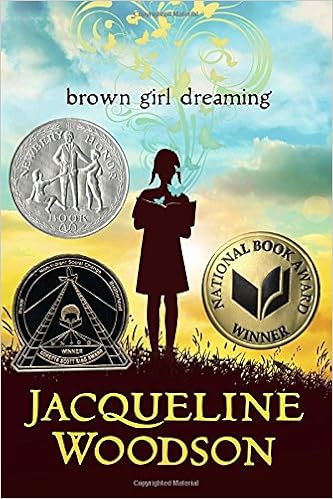
Brown Girl Dreaming

Title: Brown Girl Dreaming
Author: Jacqueline Woodson
Publisher: New York: Penguin
ISBN: 978-0-399-25251-8

Summary: Jackie was named for her father and raised by her mother during the turbulent 1960’s. Too young to comprehend the complexities of the marches, black power, and the social revolution, Jackie holds on to her family’s love as the world changes around her. Brown Girl Dreaming is Jacqueline Woodson’s autobiography.

Critical Analysis: Don’t be fooled by its title, Brown Girl Dreaming is a book for all of us—black, white, purple, boy or girl. A novel written in free verse, Woodson’s spare text is carefully chosen—just enough words to evoke an emotion and hint at complex social underpinnings. The book is made up of snippets: a haiku here, a sentence fragment there, fresh laundry, the death of a loved one. Each event is touched lightly, but solemnly.

“Somewhere in my brain
each laugh, tear and lullaby
becomes memory.”

Woodson’s words are lyrical; descriptions of the South and New York City take you there. From the yellow dots of her grandmother’s cheese grits left on the plate to the heat of a Brooklyn sidewalk, Woodson’s vivid details share with you her love for each place.  She crafts her poetry not only with affection for the words, but also with attention to the surrounding space, leaving room for self-reflection.

Although it is a coming-of-age book, no single event marks the line between childhood and young womanhood. The self-awareness of the author is built line upon line, poem after poem. The final poems of the novel are exclamations of personal belief.

“I believe in one day and someday and this
            perfect moment called Now.”

The book begins with a family tree and ends with photographs of the people you have come to know. Jacqueline Woodson’s free-style poetry will remind you of the pull of home, wherever that may be.

Awards:
National Book Award 2014
Coretta Scott King Book Award 2015
Newberry Honor Book 2015
Margaret A. Edward Award for Lifetime Achievement

Reviews:

New York Times: “The triumph of “Brown Girl Dreaming” is not just in how well Woodson tells us the story of her life, but in how elegantly she writes words that make us want to hold those carefully crafted poems close, apply them to our lives, reach into the mirror she holds up and make the words and the worlds she explores our own. This is a book full of poems that cry out to be learned by heart. These are poems that will, for years to come, be stored in our bloodstream.”
National Book Foundation: “…an intimate journey of victory, sorrow, and discovery. Sharp social commentary of a country’s struggle to live up to its ideals, an honest portrayal of the strength of family, and the delicate blossoming of a young writer make this memoir in verse a gift to all who read it.”
Kirkus Reviews:Woodson cherishes her memories and shares them with a graceful lyricism; her lovingly wrought vignettes of country and city streets will linger long after the page is turned.”
Author Quote:
Regarding memories: “It comes in these small moments with all of this white space around it, and I think that that’s what you get in reading [Brown Girl Dreaming]—you get that small moment…then the moments are of course linked together to tell the story.” –NPR Fresh Air interview, 12/10/14
Extras:
Listen to author Jacqueline Woodson on the NPR show Morning Edition 9/19/14
http://www.npr.org/sections/codeswitch/2014/09/18/348992638/jacqueline-woodson-on-being-a-brown-girl-who-dreams

Activities:
A great resource with lots of activities using Brown Girl Dreaming as a springboard:
http://www.literacyworldwide.org/blog/literacy-daily/2014/10/02/putting-books-to-work-i-brown-girl-dreaming-i-
Created for course 5603.21 at Texas Woman's University

Tuesday, October 6, 2015

The Surrender Tree: Poems of Cuba's Struggle for Freedom

Title: The Surrender Tree: Poems of Cuba’s Struggle for Freedom
Author: Margarita Engle
Publisher: New York: Holt, 2008
ISBN: 978-0-8050-8674-4

Summary: Told through the eyes of five distinct narrators, The Surrender Tree is based on the true story of Rosa la Bayamesa and her husband José Francisco Varona. She was a prominent healer during Cuba’s struggles for Independence from 1850-1899 and he helped to establish and defend the many jungle hospitals they served.

Critical Analysis: Told entirely through free verse, Margarita Engle’s novel is a wonderful introduction to an inspiring real-life hero from Cuba’s many revolutions from the 1850 to 1899. Five narrators bring their own perspective to the violent events of the time. The table of contents breaks the book into five parts representing consecutive periods of Cuban history: chafing under Spanish Rule, the Ten Years’ War, the Little War, the War of Independence, and the Spanish surrender to the United States ending the Spanish-American War. Engle includes a timeline and author and historical notes to expand our understanding of the events surrounding her characters.

We first meet Rosa, our heroine, as a girl. A slave blessed with healing talents, she shares her gift not only at her master’s bidding, but also with rebels and runaway slaves. Rosa’s tone is straightforward—she is simply using her gift of healing. The next character is Lieutenant Death, a young man who is an eager apprentice of his ruthless slave-hunting father. Lieutenant Death becomes obsessed with the destruction of Rosa the witch-girl. While these characters are young belief in ghosts and the supernatural is frequently mentioned.

By the time Rosa’s owner takes part in the Ten Years’ War, Rosa is a young woman. Her owner frees her and Rosa meets and marries our third narrator, José. José quickly establishes himself as a practical man sharing a knack for simile and metaphor with Rosa.

“I picture the two of us, carved and polished,
motionless, yet alive, 
holding up our roof of hope.”

Over the ensuing years a reader can sense our heroes growing exhausted of constant warfare. José says:

“Sometimes war feels
like a lonely child’s game, 
one that explodes
out of control.”

Lieutenant-General Valeriano Weyler y Nicolau, Marquis of Tenerife, Empire of Spain, (known as General Weyler in the history books), is sent to subdue the Cuban rebellion. His pompous words are full of disdain for Spain’s Cuban population. He ruthlessly forces peasants into “reconcentration” camps, the forerunner of Hitler’s concentration camps. Our final narrator, a young girl named Silvia, escapes the reconcentration camp and joins Rosa as an apprentice. By this time Rosa is an old woman, weary of war and fear, but still trying to heal all who come to her.

The U. S. victory in the Spanish-American War suddenly ends the Cuban rebellions. José and Rosa take the victory with a grain of salt, seeing the American occupation as yet another blow to Cuban independence. The young Silvia sees the occupation as a fresh start, stability for Cuba.

That Engle has distilled such a long chaotic period into just 137 brief poems is a testament to her wordcraft. She manages to continually add depth and experience to her characters using only the barest of words, catching and holding us with matter-of-fact poetry punctuated with profound metaphors and similes.  The emotional impact of the story grows as the characters mature—to borrow imagery from Engle—from the airy balsa wood of youth to the dense wood of the guayacán tree.

Awards:
Pura Belpre Award 2009
Newbery Honor Book 2009
Bank Street-Claudia Lewis Award 2009
Bank Street-Best Children’s Book of the Year 2009
ALA Best Books for Young Adults
Junior Library Guild Selection

Reviews:
“Engle writes her new book in clear, short lines of stirring free verse. Caught by the compelling narrative voices, many readers will want to find out more.” – Booklist

A powerful narrative in free verse . . . haunting.” - The Horn Book

“Hauntingly beautiful, revealing pieces of Cuba's troubled past through the poetry of hidden moments.” - School Library Journal

Also by Margarita Engle:
The Poet Slave of Cuba: A Biography of Juan Francisco Manzano - ISBN  978-0312659288
The Firefly Letters: A Suffragette’s Journey to Cuba - ISBN 978-0805090826
Tropical Secrets: Holocaust Refugees in Cuba - ISBN 978-0805089363

More Activities:
A great resource with links to PBS, National Geographic, and many others (including a five minute video “Cuba for Kids”).

Created for course 5603.21 at Texas Woman's University