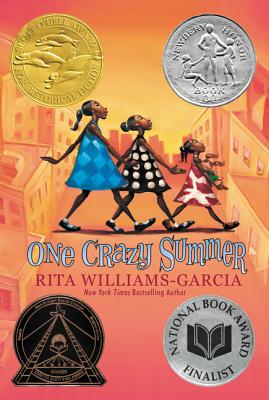
 Title: One Crazy Summer
Author: Rita Williams-Garcia
Publisher: New York: HarperCollins, 2010
ISBN: 978-0-06-076090-8
Summary: “How can you send them to Oakland? Oakland’s
nothing but a boiling pot of trouble cooking.”
–Big Ma
It’s the summer
of 1968 and Delphine and her two younger sisters are sent by their father and
Big Ma (their grandmother) in Brooklyn, NY, to Oakland, CA, to visit their mother.
But their California dreaming crashes down on them as they realize they will
not be visiting Disneyland and surfing as they had hoped. Instead they are busy
avoiding the crazy mother who abandoned them as babies, attending summer school
taught by black panthers, and a learning a few truths they never knew. Just
don’t tell their Big Ma.
Critical Analysis: Rita Williams-Garcia creates not so much
a world (that was already there) as the people that inhabit it—especially the
women. Delphine, Vonetta, and Fern are sisters ranging in age from 11 to 7,
each with her own strong personality. Their mother, Cecile or Nzila, is crazy
and distant, a poet quietly caught up in the black power movement of the 1960’s.
Their grandmother, Big Ma, is heard throughout the story as a conservative
voice in the head of our narrator.
The story is
told through the eyes of 11-year-old Delphine. When their mother abandoned them
Delphine took on responsibility for her younger sisters. The reader senses her vigilance
in guarding Vonetta and Fern, her big-sister ability to press the right buttons
in her younger sister’s attitudes, and her resentment toward her mother for
leaving them. We see Delphine’s comprehension about the way the world works slowly
shift as she is exposed to the ideals of the Black Panthers and her evolving role
as a black woman.
The novel
revolves around the sisters, especially Delphine, and their relationship with
their mother. While the girls essentially wait for their mother to acknowledge
their existence beyond people who need to be fed and sleep somewhere, they
become involved in a summer education program run by the Black Panthers at the
People’s Center.
Their
adventures at the People’s Center are just like any other children’s in any summer
school; there are friends to be made from enemies, playground games, teachers
trying (sometimes succeeding) to help. Then Nzila is arrested with a couple of
Black Panthers and the girls are left on their own. Instead of calling Pa and
Big Ma, Delphine decides to wait for Cecile to be released from jail. The
sisters stay busy with preparations for a rally in the park. The girls discover
a poem written by their mother and decide to recite it as their part in the
rally. The plot is quickly but powerfully resolved as Cecile finally speaks to
Delphine about why she left.
Rita
Williams-Garcia writes not only from her personal knowledge of growing up
during the civil rights movement, but also from extensive research from a
variety of sources. The descriptions of the time and area are accurate. Even
the stereotyping is accurate—meaning that some of the characters view other
characters as stereotypes, such as one of the Panthers continually calling the
police “pigs”.
The book may be
written in a certain time and a certain place, but the characters could be in
any setting. The girls’ pain and confusion as a consequence of abandonment and
how they deal with facing the unknown are emotions we are all familiar with to
one extent or another. Delphine is not alone in having to come to terms with
the underlying motivations to action; it is something we all must face.
Awards:
Newberry
Honor Book
Coretta
Scott King Award
National
Book Award Finalist
Scott
O’Dell Award for Historical Fiction
ALA
Notable Book
NAACP
Image Award Nominee
Parent’s
Choice Gold Award
Reviews:
Monica Edinger,
New York Times: “In One Crazy Summer
Williams-Garcia presents a child’s-eye view of the Black Panther movement
within a powerful and affecting story of sisterhood and motherhood.”
Horn
Book: “The setting and time period are as vividly realized as the characters,
and readers will want to know more about Delphine and her sisters after they
return to Brooklyn.”
Linda
Sue Park, Newbery Medal-winning author of A Single Shard: “A genuine rarity: a
book that is both important in its contents and utterly engaging in its
characters…with the tremendous bonus of being beautifully written.”
Author
Quote:
“I wanted to share an era in which I had enjoyed my childhood—the
late 1960’s…My siblings and I indulged in now-vanishing pastimes. We played
hard. Read books. Colored with crayons. Rode bikes. Spoke as children spoke.
Dreamed our childish dreams…[our parents] gave us a place to be children and
kept the adult world in its place—as best as they could.”
--excerpt from Rita Williams-Garcia’s Acceptance Speech for
the Coretta Scott King Author Award for One
Crazy Summer
Activity
and Websites:
Make a playlist including songs from 1968
Pretend you are eating Mean Lady Ming Takeout by trying this
recipe for fortune cookies: kidspot fortune cookies
Find out more about the Civil Rights Movement:
Created for Texas Woman’s University course LS
5603.21