Showing posts with label Poetry. Show all posts

Wednesday, October 7, 2015

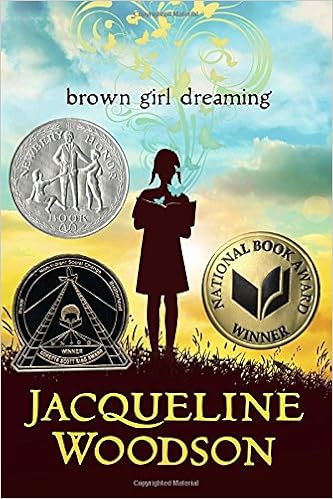
Brown Girl Dreaming

Title: Brown Girl Dreaming
Author: Jacqueline Woodson
Publisher: New York: Penguin
ISBN: 978-0-399-25251-8

Summary: Jackie was named for her father and raised by her mother during the turbulent 1960’s. Too young to comprehend the complexities of the marches, black power, and the social revolution, Jackie holds on to her family’s love as the world changes around her. Brown Girl Dreaming is Jacqueline Woodson’s autobiography.

Critical Analysis: Don’t be fooled by its title, Brown Girl Dreaming is a book for all of us—black, white, purple, boy or girl. A novel written in free verse, Woodson’s spare text is carefully chosen—just enough words to evoke an emotion and hint at complex social underpinnings. The book is made up of snippets: a haiku here, a sentence fragment there, fresh laundry, the death of a loved one. Each event is touched lightly, but solemnly.

“Somewhere in my brain
each laugh, tear and lullaby
becomes memory.”

Woodson’s words are lyrical; descriptions of the South and New York City take you there. From the yellow dots of her grandmother’s cheese grits left on the plate to the heat of a Brooklyn sidewalk, Woodson’s vivid details share with you her love for each place.  She crafts her poetry not only with affection for the words, but also with attention to the surrounding space, leaving room for self-reflection.

Although it is a coming-of-age book, no single event marks the line between childhood and young womanhood. The self-awareness of the author is built line upon line, poem after poem. The final poems of the novel are exclamations of personal belief.

“I believe in one day and someday and this
            perfect moment called Now.”

The book begins with a family tree and ends with photographs of the people you have come to know. Jacqueline Woodson’s free-style poetry will remind you of the pull of home, wherever that may be.

Awards:
National Book Award 2014
Coretta Scott King Book Award 2015
Newberry Honor Book 2015
Margaret A. Edward Award for Lifetime Achievement

Reviews:

New York Times: “The triumph of “Brown Girl Dreaming” is not just in how well Woodson tells us the story of her life, but in how elegantly she writes words that make us want to hold those carefully crafted poems close, apply them to our lives, reach into the mirror she holds up and make the words and the worlds she explores our own. This is a book full of poems that cry out to be learned by heart. These are poems that will, for years to come, be stored in our bloodstream.”
National Book Foundation: “…an intimate journey of victory, sorrow, and discovery. Sharp social commentary of a country’s struggle to live up to its ideals, an honest portrayal of the strength of family, and the delicate blossoming of a young writer make this memoir in verse a gift to all who read it.”
Kirkus Reviews:Woodson cherishes her memories and shares them with a graceful lyricism; her lovingly wrought vignettes of country and city streets will linger long after the page is turned.”
Author Quote:
Regarding memories: “It comes in these small moments with all of this white space around it, and I think that that’s what you get in reading [Brown Girl Dreaming]—you get that small moment…then the moments are of course linked together to tell the story.” –NPR Fresh Air interview, 12/10/14
Extras:
Listen to author Jacqueline Woodson on the NPR show Morning Edition 9/19/14
http://www.npr.org/sections/codeswitch/2014/09/18/348992638/jacqueline-woodson-on-being-a-brown-girl-who-dreams

Activities:
A great resource with lots of activities using Brown Girl Dreaming as a springboard:
http://www.literacyworldwide.org/blog/literacy-daily/2014/10/02/putting-books-to-work-i-brown-girl-dreaming-i-
Created for course 5603.21 at Texas Woman's University

Tuesday, October 6, 2015

Insectlopedia: Poems and Paintings

Title: Insectlopedia: Poems and Paintings
Author/Illustrator: Douglas Florian
Publisher: San Diego: Harcourt Brace & Co., 1998
ISBN: 0-15-201306-7

Summary:
Insectlopedia is a collection of poems and paintings by Douglas Florian focusing on common insects, many of which can be found in your backyard.  

Critical Analysis:
Featuring twenty-one poems about common insects, Douglas Florian’s Insectlopedia is a humorous whirlwind tour of the North American insects. A fine balance of humor and fact is struck in each rhyming poem, making them not only laugh-out-loud funny but also an invitation to find out more about the insect. The bugs are personified comically—the black widow refuses to wear denim and giant water bugs never get cards for Father’s Day. Although rhythm features in all the poems, it is strongest for the weevils and army ants--practically marching.

“We are weevils.
We are evil.
We’ve aggrieved
Since time primeval.” 

The illustration accompanying each poem is watercolor and collage on a primed paper-bag, an unusual and visually interesting combination; many insects have funny expressions or use human props. Looking at the pictures, it seems that Florian had a lot of fun painting them and you’d like to try the technique yourself—just to see what happens. However, the painted illustrations aren’t the only visual fun. The whirligig beetles’ text spins round and round while the inchworm’s poem’s text wiggles up and down.

If you are reading these poems to a group of young children, expect giggles. If you read this book to yourself, expect the same. The table of contents will help you find just the bug you are looking for--unless you want a stinkbug or a dung beetle. Sadly, those two are not in the book.

Awards:
Douglas Florian has won the Lee Bennett Hopkins Poetry Award, and ALA Notable Children’s Book Award for his book Beast Feast.

Reviews:
Scholastic: “Insectlopedia transforms the natural world into a realm where language, art, and entomology join with humor and imagination for a unified flight of fancy. And the spell it casts is greater than the sum of its parts.

Publishers Weekly: "The silly, imaginative verses about whirligig beetles and waterbugs (almost) match the exquisite pictures in playfulness and wit. The result is downright stunning."

Booklist: “The clever artwork, deftly constructed, and the entertaining collection of insect and arachnid verse it illustrates will delight readers.

More by Douglas Florian:
Mammalabilia - ISBN 978-0152050245
Lizards, Frogs, and Polliwogs - ISBN 978-0152052485 
Beast Feast - ISBN 978-0152017378

Author Quote:
“In poetry you can pull or push words, s t r e t c h words, shape words, invert words, invent words, use bad grammar, bad spelllling, or anything that makes the poem better. That’s poetic license, and I get mine renewed every Thursday.”
- http://www.curledupkids.com/intervue/intflori.htm

Activities:
Raise a caterpillar to a butterfly

Take a nature tour to seek out bugs

Created for course 5603.21 at Texas Woman's University

The Surrender Tree: Poems of Cuba's Struggle for Freedom

Title: The Surrender Tree: Poems of Cuba’s Struggle for Freedom
Author: Margarita Engle
Publisher: New York: Holt, 2008
ISBN: 978-0-8050-8674-4

Summary: Told through the eyes of five distinct narrators, The Surrender Tree is based on the true story of Rosa la Bayamesa and her husband José Francisco Varona. She was a prominent healer during Cuba’s struggles for Independence from 1850-1899 and he helped to establish and defend the many jungle hospitals they served.

Critical Analysis: Told entirely through free verse, Margarita Engle’s novel is a wonderful introduction to an inspiring real-life hero from Cuba’s many revolutions from the 1850 to 1899. Five narrators bring their own perspective to the violent events of the time. The table of contents breaks the book into five parts representing consecutive periods of Cuban history: chafing under Spanish Rule, the Ten Years’ War, the Little War, the War of Independence, and the Spanish surrender to the United States ending the Spanish-American War. Engle includes a timeline and author and historical notes to expand our understanding of the events surrounding her characters.

We first meet Rosa, our heroine, as a girl. A slave blessed with healing talents, she shares her gift not only at her master’s bidding, but also with rebels and runaway slaves. Rosa’s tone is straightforward—she is simply using her gift of healing. The next character is Lieutenant Death, a young man who is an eager apprentice of his ruthless slave-hunting father. Lieutenant Death becomes obsessed with the destruction of Rosa the witch-girl. While these characters are young belief in ghosts and the supernatural is frequently mentioned.

By the time Rosa’s owner takes part in the Ten Years’ War, Rosa is a young woman. Her owner frees her and Rosa meets and marries our third narrator, José. José quickly establishes himself as a practical man sharing a knack for simile and metaphor with Rosa.

“I picture the two of us, carved and polished,
motionless, yet alive, 
holding up our roof of hope.”

Over the ensuing years a reader can sense our heroes growing exhausted of constant warfare. José says:

“Sometimes war feels
like a lonely child’s game, 
one that explodes
out of control.”

Lieutenant-General Valeriano Weyler y Nicolau, Marquis of Tenerife, Empire of Spain, (known as General Weyler in the history books), is sent to subdue the Cuban rebellion. His pompous words are full of disdain for Spain’s Cuban population. He ruthlessly forces peasants into “reconcentration” camps, the forerunner of Hitler’s concentration camps. Our final narrator, a young girl named Silvia, escapes the reconcentration camp and joins Rosa as an apprentice. By this time Rosa is an old woman, weary of war and fear, but still trying to heal all who come to her.

The U. S. victory in the Spanish-American War suddenly ends the Cuban rebellions. José and Rosa take the victory with a grain of salt, seeing the American occupation as yet another blow to Cuban independence. The young Silvia sees the occupation as a fresh start, stability for Cuba.

That Engle has distilled such a long chaotic period into just 137 brief poems is a testament to her wordcraft. She manages to continually add depth and experience to her characters using only the barest of words, catching and holding us with matter-of-fact poetry punctuated with profound metaphors and similes.  The emotional impact of the story grows as the characters mature—to borrow imagery from Engle—from the airy balsa wood of youth to the dense wood of the guayacán tree.

Awards:
Pura Belpre Award 2009
Newbery Honor Book 2009
Bank Street-Claudia Lewis Award 2009
Bank Street-Best Children’s Book of the Year 2009
ALA Best Books for Young Adults
Junior Library Guild Selection

Reviews:
“Engle writes her new book in clear, short lines of stirring free verse. Caught by the compelling narrative voices, many readers will want to find out more.” – Booklist

A powerful narrative in free verse . . . haunting.” - The Horn Book

“Hauntingly beautiful, revealing pieces of Cuba's troubled past through the poetry of hidden moments.” - School Library Journal

Also by Margarita Engle:
The Poet Slave of Cuba: A Biography of Juan Francisco Manzano - ISBN  978-0312659288
The Firefly Letters: A Suffragette’s Journey to Cuba - ISBN 978-0805090826
Tropical Secrets: Holocaust Refugees in Cuba - ISBN 978-0805089363

More Activities:
A great resource with links to PBS, National Geographic, and many others (including a five minute video “Cuba for Kids”).

Created for course 5603.21 at Texas Woman's University